
Recently, I posited that the production of Poitín had experienced a slowdown since Brendan of Killowen declared 2022 as the ‘Year of Poitín.’ Fortunately, I am pleased to report that the perceived ‘slowing down’ was just a minor hiccup. Poitín is now exported to numerous countries worldwide, with exports expected to grow to 1 million cases by 2025. However, a pressing question has emerged: is the production of Poitín in Ireland truly worthwhile given its potential?
One of the most acclaimed Poitín producers, and a well-loved choice amongst the writers at the Water of Life, is Baoilleach distillery. Recently, they brought to my attention a matter that might not hold significance for many but is undeniably crucial for a select few. It revolves around what some might perceive as an alarming cost associated with producing Poitín in Ireland. When attempting to purchase from Baoilleach’s website, I encountered a hurdle as Michael O’Boyle had ceased shipping to the UK—a not uncommon occurrence, given the ramifications of Brexit. However, a more substantial issue emerged. The cost of obtaining a Geographical Indicator (GI) in Ireland could potentially reach up to €1250 for distillers and possibly bottlers as well. This sum is distributed across various stages of Poitín production, with each step—brewing, fermentation, distillation, maturation, and bottling—incurring a fee of €250.

I understand that for many, this might seem like a minor concern, but for craft, small-scale producers in Ireland of which the majority make poitín before whiskey production, it has become a significant issue. So much so that Baoilleach has temporarily halted Poitín production. The exorbitant cost is perplexing and pinpointing the exact reasons can be challenging. According to insights shared by Brendan over a year ago, the creation of the Irish whiskey technical file was shaped in consultation with and ratified by the ‘bigger’ distillers. Unfortunately, this has resulted in smaller distilleries being effectively ‘priced out’ of obtaining a Geographical Indicator (GI) for production. To put it into perspective, Baoilleach would need to sell 30 bottles of Poitín just to break even, and this calculation doesn’t even factor in all the operational costs associated with running a distillery—such as power, labour, bottling and every other type of resources.
Certainly, while I emphasise the point that the Geographical Indicator (GI) is inherently invaluable for some, it’s crucial to acknowledge its vital significance for others. However, the current predicament has underscored a broader issue with the outdated Irish whiskey and Poitín technical files, signalling a pressing need for a comprehensive rewrite or, at the very least, an update. I propose a consideration for the size and production output of distilleries in the revised framework. Is it equitable for distilleries like Baoilleach and Killowen to bear equivalent costs to larger counterparts such as Bushmills or Midleton (even though they do not produce Poitín)? The idea is to foster fairness and adaptability within the industry.

Given that the Irish poitín file was drafted in February 2015, it’s nearly a decade out of date. The landscape of Ireland’s whiskey and poitín industry has undergone fundamental changes over the past 10 years, not to mention the last two decades. It is high time to institute meaningful changes to ensure fairness and sustainability for the betterment of the industry.
Speaking of substantial changes, Poitín Now brought forth some truly exquisite and innovative poitín to the market last year, warranting closer examination. As we’ve discerned, the poitín landscape in Ireland is evolving into a highly competitive and crowded arena. To gain a distinctive edge, Blackwater Distillery has ventured into uncharted territory with its release of ‘Malt na Mara.’ This poitín is crafted by malting barley through the immersion of grains in briny kelp beds. The mash composition, featuring 50% Malt na Mara, 30% raw barley, 10% performer rye, 5% turf-malted oats, and 5% husky oats (transparently outlined on the bottle itself), has certainly captured the attention of poitín producers nationwide. Interestingly Blackwater have opted to bottle their spirit within 200ml bottles; a tactic also adopted most recently by Redacted bottlers; could this be a tactic to keep poitín or even whiskey production more financially sustainable? Maybe it’s psychological- producing spirits in a 200ml bottle for £40 sounds better than £130 for a standard sizing of 700ml, doesn’t it?
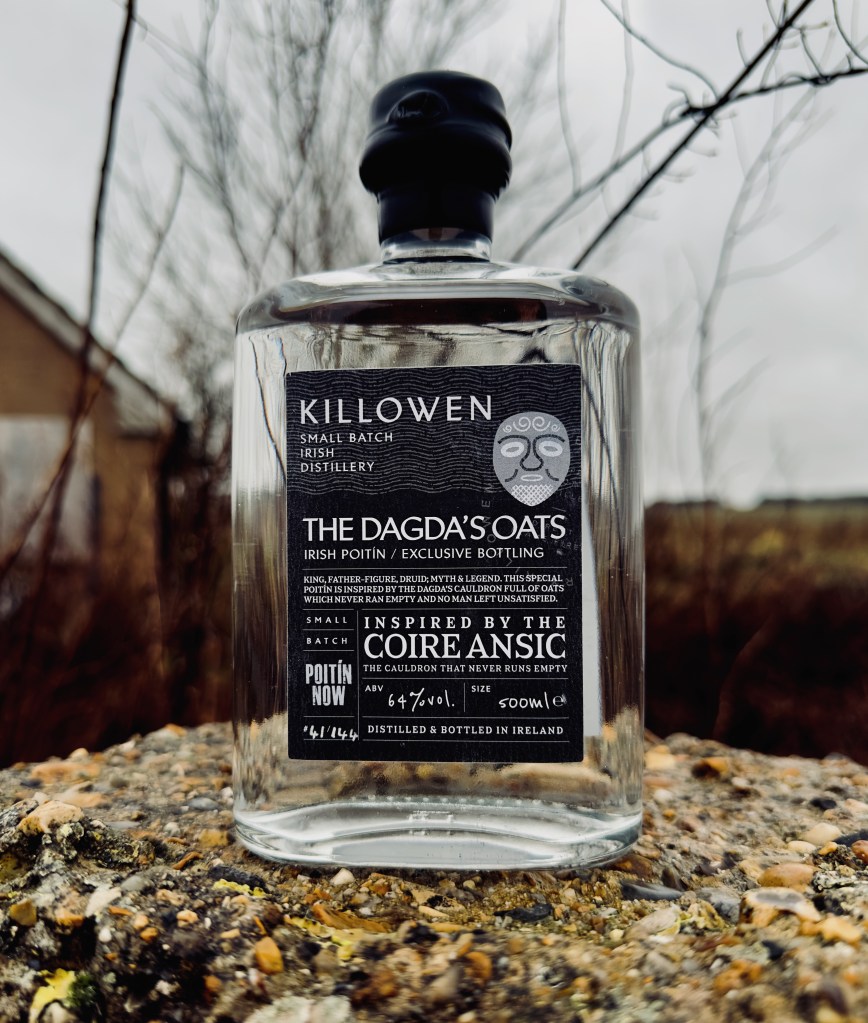
Similarly, Killowen consistently favours the use of a 500ml bottle, the same size chosen for their latest poitín produced for Poitín Now. Named ‘The Dagda’s Oats,’ this reference hails from Irish mythology, specifically Dagda, a significant and potent deity linked to the earth, fertility, and agriculture. A key member of the Tuatha Dé Danann, a group of supernatural beings in Irish lore, Dagda is renowned for his magical prowess.

In mythology, Dagda assumes the role of a paternal figure, wielding a formidable club capable of both ending and restoring life. The association with a mystical cauldron, known as the “Cauldron of Plenty” or the “Undry,” adds to the richness of his character, symbolising an endless abundance of food. In crafting ‘The Dagda’s Oats,’ Brendan, always a storyteller, sought to highlight not only the poitín’s elevated oat content but also the profound significance intertwined with Poitín Now and its commitment to generosity. This endeavour aligns seamlessly with Killowen’s ongoing dedication to poitín production.
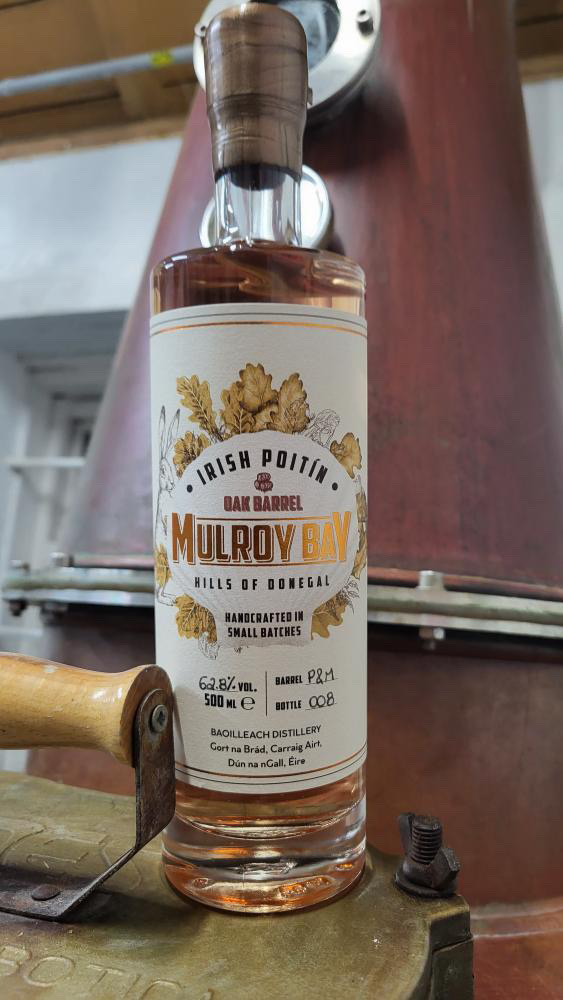
In a parallel fashion, Baoilleach similarly embraced the allure of a 500ml bottle for their latest offering, the ‘Oat Mash Marsala and Port’ finished poitín under the Poitín Now label. This release underscores Michael’s adeptness in harnessing the exquisite marriage of marsala and port as a finishing touch in cask maturation. As Michael’s relentless quest for exceptional poitín draws to a close with the Cratur, could this exclusive Poitín Now creation mark the pinnacle of his craft, ensuring his departure from poitín production is nothing short of spectacular?
Blackwater ‘Malt Na Mara’ Poitín
ABV: 50%
Price: €25 (available from their webshop)
Nose: Instantly, there’s almost a menthol and buttery distinctiveness to it. It’s quite sweet but also brings freshness with it, almost like cold cut grass. There’s a very nice, subtle aniseed note too, mixed with some marzipan. Lemon zest, lime juice and fizzy cola bottles bring quite a sharp, sweet nose to this.
Palate: Carrying on from the nose, there’s an initial sweetness burst with lemon starburst and spice too. Lots of aniseed and cinnamon with a heat that follows through exponentially. Smokiness is prevalent too, almost stale-like and quite dry. Definite saltiness to it as well, briney like.
Finish: a little bit peppery, flat coke and more subtle stale smoke and quite musty

Score: 8/10
Killowen ‘The Dagda’s Oats’ Poitín
ABV: 64%
Price: €50 (all sold out!)
Nose: beautiful salted buttery nose straight away with an air of sour boiled sweets. There’s some lemon sherbets and cinnamon lozenges too, bringing some slight bitterness and spice punch. Additionally, there’s a pepperiness too along with some rye bread.
Palate: wow, there’s so much intensity and flavour that comes right at you. Firstly, there’s a big tongue coating of aniseed and clove, which then morphs to chili chocolate with the most dreamy textures. There’s peppery lemon rind and more boiled sweets. Texture is incredible, almost chewable Murray mints.
Finish: very sweet and sticky. Sour cherries and cinnamon spice to finish.
Score: 8/10

Baoilleach Mulroy Bay – Irish Poitín – Oat Mash – Rested 6 weeks – 2nd Fill Port & Marsala
ABV: 62.8%
Price: £46 (all sold out!)
Nose: buttery cream to begin with an a subtle perfumey note too. Sour Cherry tangfastics, maraschino cherries and lemon starburst. There’s a lovely, sweet lemon note, that reminds me of cakey lemon drizzle. Lots of dried cranberry notes too with that characteristic Baoilleach sweetness coming through tenfold.
Palate: more tangfastics notes coming through, especially cherry. Then there’s fizzy cherry coke and kirsch cherry liqueurs. The spice is also there, clear cinnamon lozenges and clove, with a hint of nutmeg too. The texture is beautiful too, creamy and luxurious, but doesn’t take away from the impact of the flavours.
Finish: a little ginger comes through with a hint of zesty green apple and some cinnamon included wethers originals
Score: 7.5/10

Conclusion
Undoubtedly, these three exclusive releases for Poitín Now have exceeded expectations. They stand as exemplary representations of how Poitín should be crafted and cherished. However, therein lies a dilemma. Once we establish a benchmark for Poitín, the imperative becomes an ongoing pursuit of excellence, mastery, and endurance. Yet, the unsettling prospect that Poitín itself might fade into history for some raises a significant concern in my view.
It’s unfortunate that Michael from Baoilleach has halted the production of poitín, as his 2nd fill port and marsala poitín truly showcase his dedication to craftsmanship and his knack for extracting rich flavours from such a young spirit. Killowen consistently impresses me with the quality of their poitín releases, demonstrating Brendan’s remarkable ability to bring out depth and creativity from intricate and compelling mashbills. Brendan says this spirit is a challenge to the Bulcàn, and possibly the spirit they’ve produced, it’s good, but I’m not certain it’s better. Lastly, Blackwater’s release signals a newer generation of poitín makers who aren’t afraid to push boundaries, experimenting with new techniques, strategies, and ideas. I believe this innovative approach is essential for preserving the vitality of poitín.
You might be wondering, what’s the solution? Well, there are several potential approaches. We’ve consistently emphasized the necessity for a thorough overhaul of the technical file, or at the minimum, certain aspects of it. Moreover, it appears equitable to factor in the distillery’s yield when determining the pricing for each stage of distillation. This consideration aligns with the principles of fairness. Additionally, exploring alternative pricing models that integrate the yield of the distillery could promote fairness and sustainability in the industry. Collaborative discussions among stakeholders might pave the way for innovative solutions that address these multifaceted challenges.
Preserving the legacy of Poitín is not just a matter of maintaining a benchmark; it’s a commitment to ensuring the survival of a rich cultural tradition. The potential fading of Poitín into history underscores the need for a collective effort to appreciate and sustain this unique spirit. It calls for a renewed dedication to its craft, an exploration of innovative techniques, and an active promotion of its cultural significance. Perhaps, by fostering a deeper understanding and widespread appreciation, we can mitigate the risk of Poitín becoming a mere relic of the past. The challenge lies not only in maintaining the standards set by these exceptional releases but also in securing a future where Poitín continues to thrive and evolve.
 The Water Of Life
Hiya Water Boys, I tried opening the link to read this informative story/review but unable to do so.”Can’t be found”. I’ve been reading your reviews for over a year now & their always enjoyable & a guide to good Whiskey.The biggest surprise has been how good The Two Stacks releases have been & I’ve bought (quick check) 5 whiskies & the cream liqueur so far.Thankyou for your guidance. Looking forward to your future posts, Jim.
Get Outlook for Androidhttps://aka.ms/ghei36 ________________________________
Hi Jim- thanks so much for the comment. We delayed the release of it by a day, so hopefully you got to read it today! Glad we could help guide you in your whiskey journey, you’re certainly on the right path with two stacks! Thanks again!