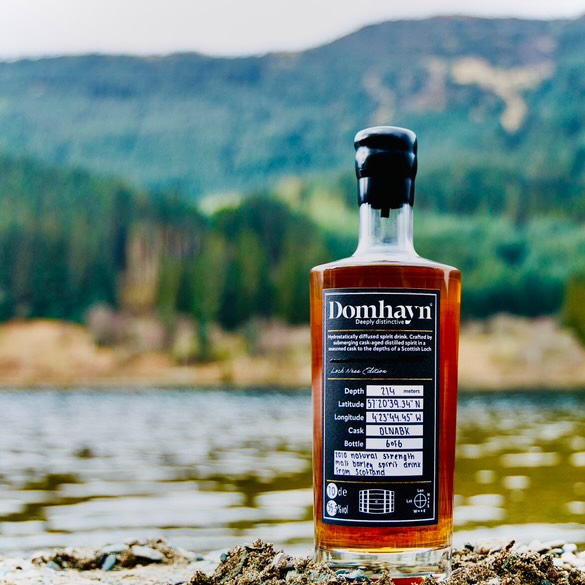
In an age where competition is fierce and many whiskies blend into one another, any brand that dares to break the mould is bound to stand out. Sometimes, it’s the subtle shifts; tweaks in packaging, labelling, or branding that make the difference. But one brand is taking innovation much further. Domhayn is reimagining whisky at a fundamental level, altering its very molecular composition. This bold approach represents a groundbreaking new vision for what whisky can be.
Domhayn, named after the Gaelic word for “deep” was born from an unexpected spark of inspiration. Its owner, James Patterson, was watching wild swimmers enjoy a celebratory dram after a chilly dook in Loch Ness when the idea struck: what if a whisky cask could be submerged too? It’s not the first time whisky innovators have asked, “what if?” Ardbeg, for instance, took things in the opposite direction, literally, by sending whisky into space to study how zero gravity affects maturation.
The transformation in their spirit isn’t just noticed by aficionados like me, it’s been scientifically validated. This isn’t about subjective tasting notes; it’s about hard data, thanks to molecular-level analysis conducted by the Department of Chemistry at the University of Oxford. To achieve this, samples from each cask were analysed using chromatography paired with mass spectrometry at Oxford.

Right, so to understand this from a normal person level, what actually happens is that Domhayn’s whisky isn’t just aged in a different way, it’s physically changed on a microscopic level. Scientists at Oxford University tested it using highly sensitive machines and found that the chemical makeup of the whisky had actually shifted. That means it doesn’t just taste different, it is different. They used a method that separates and identifies tiny compounds in the whisky to prove that submerging the casks really does cause changes deep within the spirit. So this isn’t just marketing fluff, real science backs it up.
So how did they do it? Essentially, they took a specially prepared whisky cask and submerged it deep into Scotland’s iconic Loch Ness. The depth? A staggering 214 metres. The cask ‘DLNABK’ was a small European oak barrel seasoned for 12 months with a mix of Oloroso and Pedro Ximénez sherries. It was filled with a 15-year-old, natural strength, unpeated single malt from the North East of Scotland. On Valentine’s Day 2025, it was lowered into the loch. Down there, under more than 280 PSI of pressure, the whisky experienced conditions far more extreme than anything seen in traditional aging. The intense pressure compressed the cask itself, altering the whisky in ways that normal maturation never could. You might assume it would take weeks or months to make a noticeable difference to the whisky’s flavour but think again. It took less than thirty minutes.
This whisky brand genuinely caught my attention, and I’ll admit, I cheekily reached out to James, the owner of Domhayn, fully aware that their only bottled spirits are currently up for public auction. To my surprise and delight, James graciously agreed to send me three samples. The first two were a comparison: Sample A was a control, untouched by the depths, while Sample B had been submerged. The third was something different altogether—a peated whisky that had also been immersed. Here’s what I discovered…

Spirit A: Domhayn Before Submersion:
The spirit initially presents a bright and playful nose, bursting with the sweet zing of boiled sweets and cherry Tangfastics. Citrus notes dominate, with lime peel giving it a lively sharpness, rounded out by hints of cola bottle sweets. On the palate, that same effervescent character continues; fizzy cherries mingle with lemon meringue, delivering a sweet-and-sour contrast. A subtle spice creeps in, musty and slightly earthy, giving the impression of aged wood or damp stone. It finishes with a gentle warmth, prickly and ginger-like, leaving a lightly sweet trail reminiscent of confectionery heat.
Spirit B: Domhayn After Submersion:
Post-submersion, the spirit reveals a dramatic evolution in character. The sharp citrus on the nose is now softened, with lime taking on a silkier tone. It leans into deeper candy notes, wine gums and fruit pastilles, offering a more rounded, mature profile. The palate is notably smoother and more cohesive; much of the initial harshness has mellowed, replaced by flavours of soft caramel and a delicate salinity that brings complexity and balance. The finish is mellow and elegant, with vanilla and honey coming through prominently, creating a lingering, velvety sweetness that feels much more refined.
Domhayn peated blend sample
Nose: A richly sweet and smoky bouquet, evoking burnt malt loaf drizzled with honeycomb. Hints of Madagascan vanilla bring a spiced elegance, mellow yet refined. Underneath, there’s a whisper of mulled wine laced with sea salt, adding depth and complexity.
Palate: Exceptionally smooth and beautifully balanced, with no harsh edges. The peat is subtle but distinct, just enough to remind you it’s there without overwhelming. Notes of sweet cigar ash interplay with bright clementine studded with cloves, while cinnamon lozenges provide a warming, spiced sweetness.
Finish: The warmth builds with intensity, lingering and evolving. Flavours of roast chicken crisps and bonfire embers bring a savoury-smoky twist, followed by a resurgence of clove and a refreshing touch of peppermint to round it all off.
Score: 7.5/10
Summary
So there you have it. While I’m no molecular scientist from Oxbridge, I can tell the difference between two drams, and there’s no denying the shift. What stood out most to me was how submersion mellowed the spirit. Sample A had the sharper edges you’d expect from a younger whisky, but Sample B? It was noticeably smoother, rounder, and far more drinkable. The underwater process really seems to take the sting out in a remarkably short time.
The older whisky sample was, quite simply, beautiful. While I didn’t get to try it before it went for a dip, I can imagine it might’ve had the same rough edges as the other samples, fairly harsh and maybe a bit unbalanced, which is something I often find in bold, peaty blends. But post-submersion? There’s no denying its drinkability. It instantly reminded me of Two Stacks’ Smoke and Mirrors Maple Cask—big, bold flavours, but impressively well-balanced.
So, what’s next for Domhayn? The future is their oyster, or perhaps, the sea it’s floating in. Whether they take their experiments further offshore, extend submersion times, or explore new environmental extremes, the possibilities are vast. And honestly, I’m all for it. Innovation is the lifeblood of the whisky world. Brands that don’t evolve risk being left behind by those bold enough to push boundaries and Domhayn is clearly one of those leading the charge.
Disclosure: the sample that informed this article was provided to the Water of Life team by Domhayn free of charge. Domhayn has not had any other input into this article, nor has the Water of Life team relinquished any editorial control.
 The Water Of Life