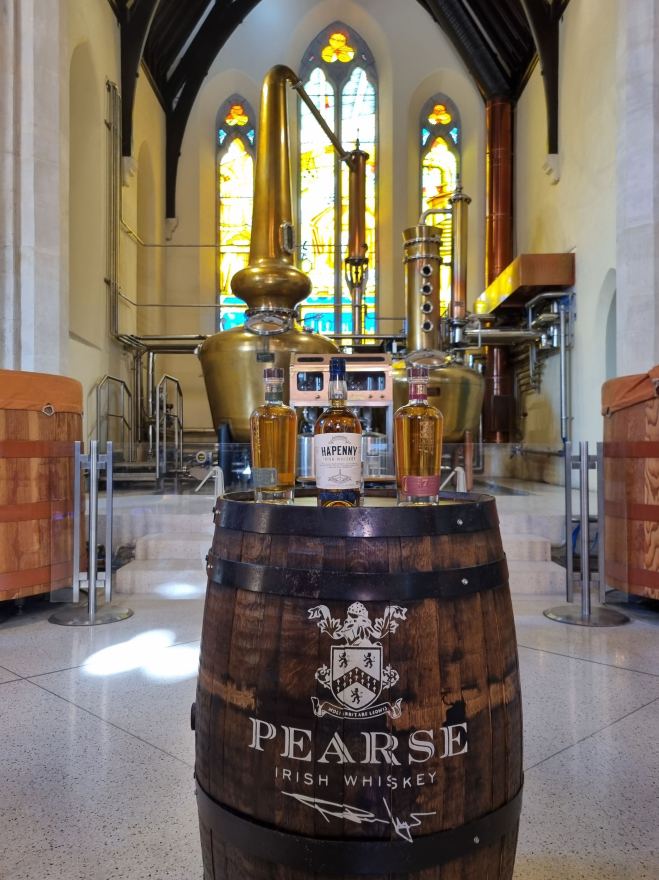
While researching a recent trip to Dublin, I was struck by a photo of a gleaming copper still framed by a beautiful stained-glass window. There was no doubt that a pilgrimage to such a still would have to form part of my itinerary. As such, on a sunny July afternoon, I found myself sweating outside the Pearse Lyons Distillery.
Dr Thomas Pearse Lyons was born and educated in Dublin before emigrating to America, where he found both success and fortune. Having founded a hugely successful animal feed firm, he later started the Kentucky based Lexington Brewing & Distilling Co, parent company of the Town Branch distillery. However, he had both family and personal links to the Irish whiskey industry, coming from a long line of coopers, and having been involved in the design of Cork’s New Midleton Distillery. This drove his ambition to open his own distillery in Ireland.
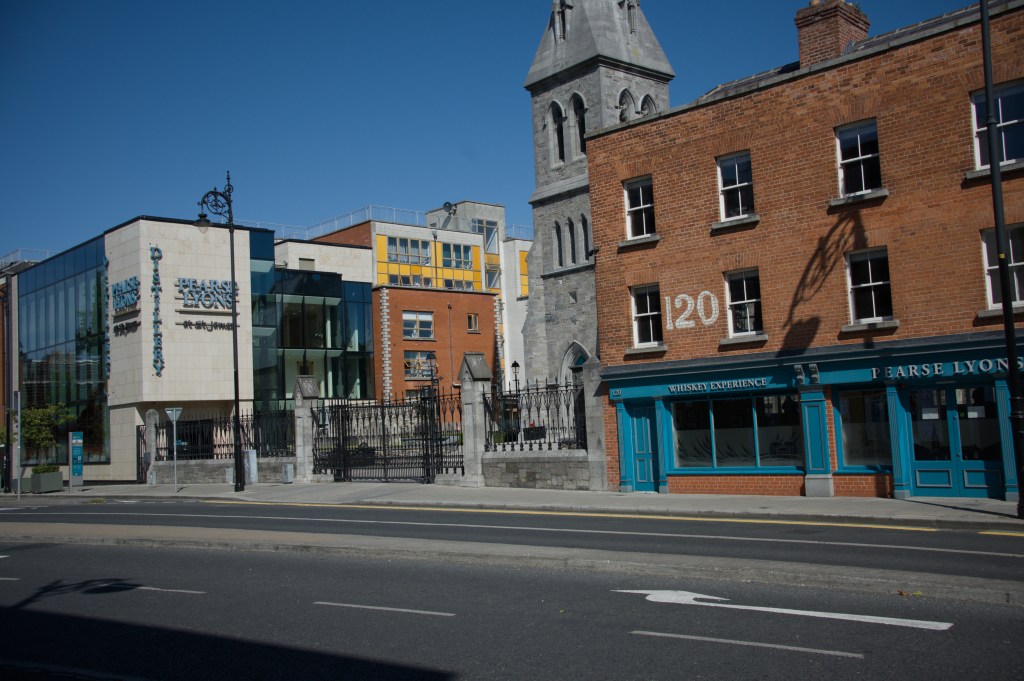
The Pearse Lyons Distillery may well be the most attractive building in the whole whiskey industry. Having been deconsecrated in 1964 and fallen most of the way into ruin, the St James’ Church in Dublin’s Liberties was bought by Pearse and Deirdre Lyons in 2013. Shortly after this purchase, the building was granted protected national monument status, which had the unpleasant side effect of requiring them to conserve the building even as they transformed it. This ballooned their budget, from an initial estimate of €7 million to over €30 million.
On first glance, it is immediately apparent how worthwhile the Lyons’ conservation efforts have been. On the sunny July afternoon that I visited, this first impression was only enhanced by the relief of the ice-cold water offered at the reception desk. This was swiftly followed by an introductory glass of the distillery’s Ha’penny Original whiskey, offered by our guide Finn while we watched the tour’s introductory video. I found the auditorium’s church pew seating to be a nice touch, enhancing the tour’s link to the site.
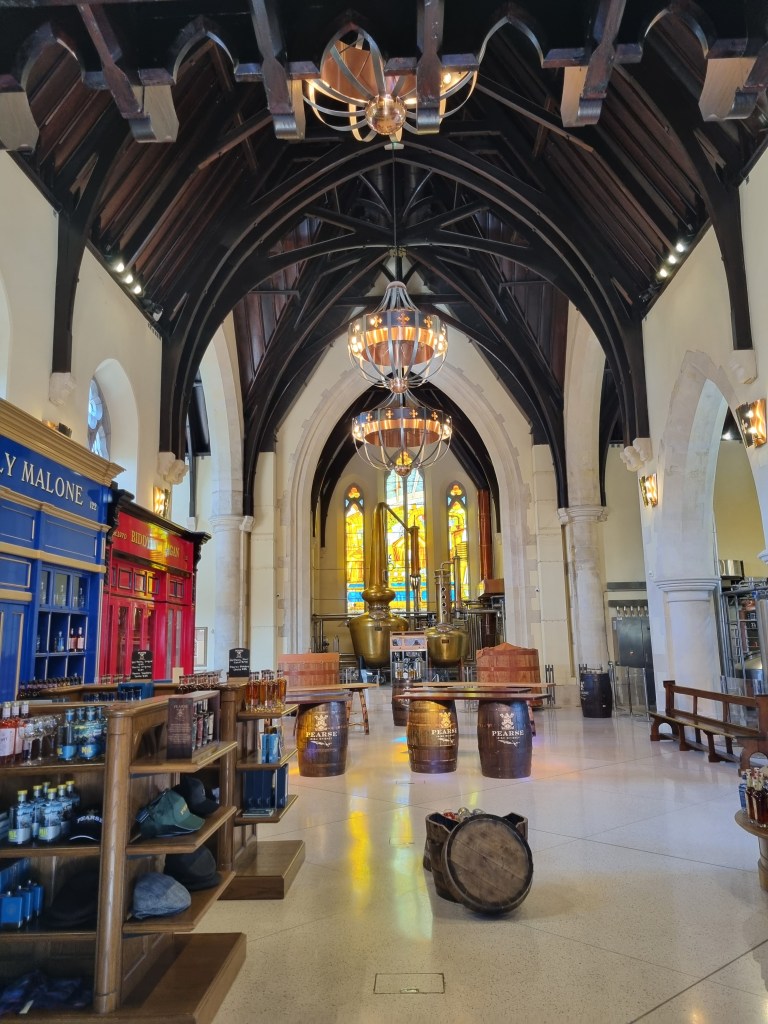
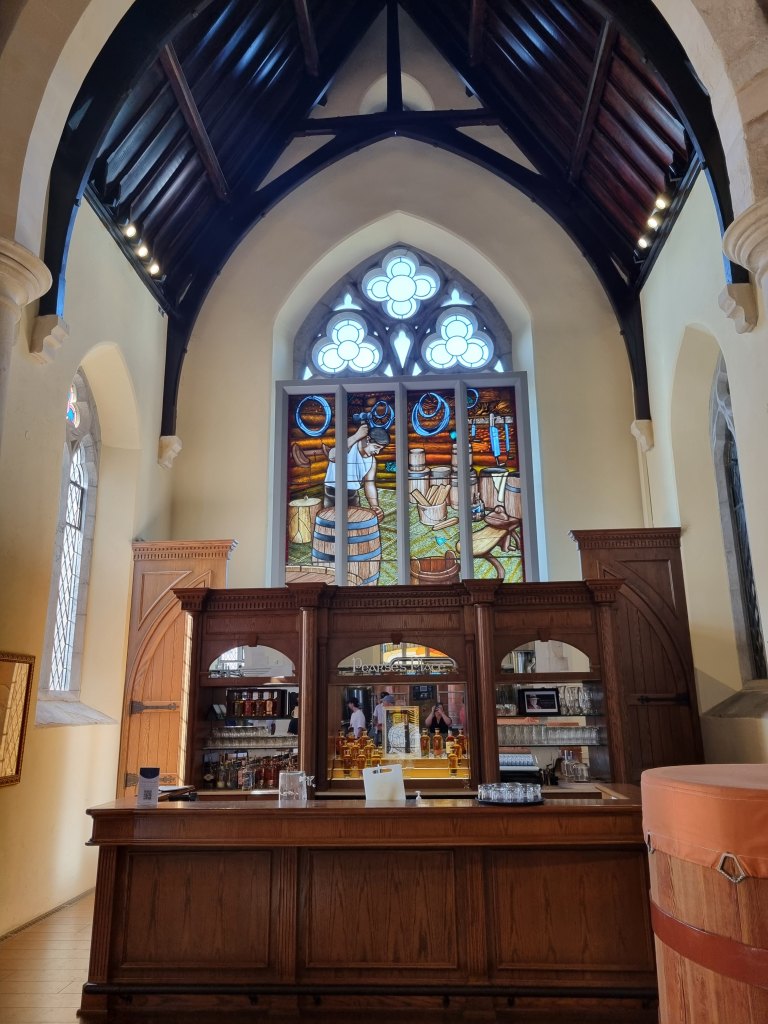
Having been impressed by the distillery’s exterior, I was amazed when we stepped inside. The traditional approach has been abandoned, with the design instead being entirely open plan, combining mash tuns, stills, tasting room, and gift shop in one beautiful space. The new stained-glass windows, homages in turn to St James, coopers, and distilling, only enhance the sacred atmosphere. At the heart of this space, where an alter might be expected, stand the distillery’s two stills – a traditional wash still and a hybrid spirit still. The latter is bottom half pot still, top half column still, apparently unique in Ireland. This allows the distillery to produce a (less traditional) double-distilled spirit while still having significant still influence. This was described as creating a “two-and-a-half still” spirit, somewhere between a traditional Irish triple-distilled whiskey and a double-distilled single malt. The scale of these stills is, however, far from vast: one run fills a single 200 litre cask.

Although at the heart of distillery’s story and striking appearance, both architecture and history prove to be constraining factors in some ways. Both maturation and bottling must take place off site. This is in part due to limitations on space, already at a premium in Dublin but exacerbated by the surrounding graveyard. The Dublin Whiskey Fire of 1875 has also led to a lingering reluctance to store large quantities of spirits within the city’s boundaries. As such, Pearse Lyons’ spirit matures in two off-site warehouses, one of which is close to their shared West Cork bottling plant. The decision to house casks in two locations is also a legacy of this fear of fire, ensuring that the distillery will have continuity of its output should disaster strike.
The tour concluded with a traditional tasting, comprising in our case (having booked the Signature tour and tasting) four samples: the 5-year-old Pearse Original, the 7-year-old Distiller’s Choice, and the Ha’penny Four Cask (a review of which will soon follow). This isn’t bad value for €27. Booking is through the distillery’s website.
With production on site only having started in 2017, this represents a decent range. It is, however, far from the distillery’s final offering, as significant changes are already underway. The distilling team is expanding to allow an increase in production, as currently only two casks are filled a week. Additionally, since 2020, the distillery began to only use barley from the family’s own farm. They have also begun to work more closely with their sister Town Branch distillery. This is already the source of their ex-bourbon casks, but now will feature in a collaborative blend, due for release soon.
Conclusion
In some ways, the Pearse Lyons Distillery does not make sense. Although it is very possibly the most beautiful building in whiskey, the €30 million investment cannot possibly justify a production capacity of around 400 litres per week, especially when sold at surprisingly reasonable rates (the Ha’penny Four Cask and the Pearse Original are both extremely competitive at the €50 price point). Financially, this makes no sense, and I doubt the family expect to ever see a return on their investment.
There can only be two possible answers to this riddle: this is either about vanity or about passion. If it were the former, it is likely that the costly renovation would have been abandoned in favour of a cheaper site elsewhere. It is also likely that the whiskey would be far more expensive, and a lot less good. As such, I can only conclude that Pearse Lyons’ distillery is all about passion for whiskey. Despite his success in America, this is the only whiskey that Dr Lyons has placed his name on; this is where he decided to truly make his mark. And what a mark it is: both distillery and dram truly stand out to me. I’m pleased that an otherwise canny businessman chose to abandon business sense with this distillery and instead make it all about the passion of whiskey.
Thomas Pearse Lyons sadly passed away in 2018. He will have only seen the beginnings of the distillery that bears his name. Nevertheless, I hope he was proud of it: it stands as a fitting tribute to his achievements.
 The Water Of Life