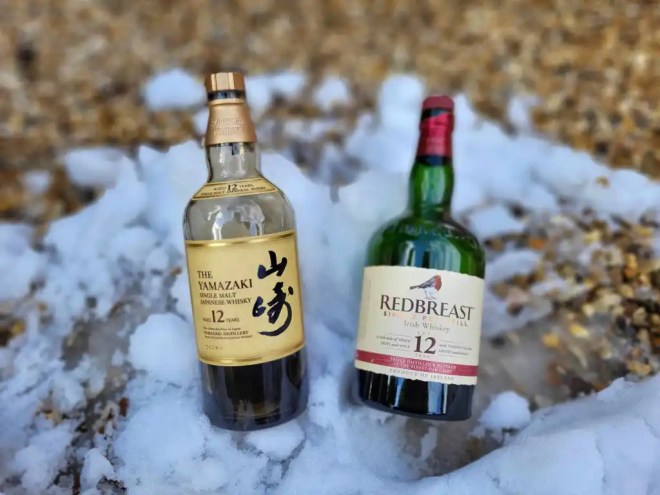
Ireland and Japan are in opposite sides of the globe. If you ask our usual readers, they probably will find it hard to list similarities between the two countries. To start, Ireland has a population of 5 million whilst Japan has 120 million over that. Japan’s capital city alone, Tokyo, has around 15 million people. From here, it’s easy to imagine and guess the societal, political, and economical difference that the size of the countries alone bring. However, once you peel the layers and start looking beyond the obvious, it’s interesting to see the parallels between these two island nations. Both are steep in cultural heritage, have a deep appreciation for nature, and have a strong sense of national identity and pride in their own history, folklore, music, dance, literature, and food.
I must confess to our mostly Irish-whiskey loving readers, I was introduced to Japanese whisky before Irish whiskey. I was drinking Yamazaki before I even had my first sip of Jameson and this was back in 2012-2013 when a bottle of Yamazaki 12 was about €40 and Yamazaki 18 was around €120 at Duty Free in Singapore Changi airport where I used to buy my bottles. With these whiskies tripling prices at retail in less than 10 years, it was great to try them at much more affordable prices. In slight contrast, my first foray into Irish whiskey was via Jameson, Ginger, and Lime – equally sumptuous but marrying an Irish woman and moving to Dublin were bigger nudges for me to delve into Irish whiskey more.
This review really came about when I was travelling through London last summer and I saw bottles of Yamazaki 12 in Heathrow Duty Free for a little over £100. I quickly nabbed one as it brought nostalgia and I know that I’m not overpaying for it considering current prices and how much they typically are in Ireland. It was a treat to have and before I finish the bottle, I wanted to write a review on it. One night over the Christmas holidays, I was having it side-by-side with a Redbreast 12. I thought to myself, these are two quintessential whiskeys for their respective categories. Are there more similarities in them or differences? That then spiralled into thinking about the wider industries. Having been exposed to the Irish whiskey industry a lot more especially in the recent years, I realise how much I didn’t know about the Japanese Whiskey industry.
This is not meant to be a crash course in Japanese whisky but I thought it was important to get up to speed with it if I was writing this review. After all, Japanese whisky is an important category for global spirits. When you see beginner’s guides to whiskey, you would often see Japanese whisky mentioned along with Scotch, Irish, and Bourbon as the main “types” of it. What parallels can we draw from the Irish and Japanese whisky industries?
Origin
It’s widely known that Japanese whisky’s roots came from Scotland in the early 20th century. Two of the most influential figures here are Shinjiro Torii and Masataka Taketsuru. Torii was a pharmaceutical wholesaler and the founder of Kotobukiya (later to become Suntory) who built the first Japanese whisky distillery in Yamazaki, a suburb of Kyoto. Torii hired Taketsuru as a distillery executive who studied the art of distilling in Scotland, and brought this knowledge back to Japan in the early 1920s. While working for Kotobukiya he played a key part in helping Torii establish the Yamazaki Distillery. In 1934 he left Kotobukiya to form his own company—Dainipponkaju—which would later change its name to Nikka.
Although Irish whiskey began centuries before, the Irish cannot also accurately claim that they invented whiskey. It is believed that Irish monks traveling to the Mediterranean learnt distillation techniques, which they brought back to Ireland around the 6th century AD. Records of aqua vitae, a precursor to whiskey as we know today, can be traced back to 1324 in the Red Book of Ossory. There’s also an abundance of early historical records in forms of licenses to distill, tax edicts, songs, and poems to name a few that can verify that uisce beatha (Water of Life, which our name is based off) is part of society during this time.
Recent History
Japanese whisky, like many other Japanese industries, grew significantly post World War II. In 1950’s, the three biggest producers competed with each other aggressively leading to their “whisky wars”. The industry continued to grow until it reached its peak in 1983 when it started to decline due to the increasing popularity of Japanese beer, shochu, and sake. In 2008, Japanese whisky began its uphill climb again driven mainly by the highball craze. It’s also the first time in 35 years that the Japanese government granted a whisky production license to a new company. This ushered in a wave of new distilleries that wanted a piece of the growing market. However, international acclaim, and the subsequent craze came later after Jim Murray’s 2015 Whisky Bible awarded the Yamazaki Sherry Cask 2013 World’s Best Whisky, the first time a Japanese whisky received the coveted title. It started an avalanche of awards and eventually attention from global pundits.
Irish whiskey from its monastic roots grew and was industrialised like other commodities. It had its first spurt in the 1700s as a by-product of increased grain production throughout the country in support of the British empire. In the early 1800s, Dublin production accounted for the majority as is being the home to the largest whiskey producers in the world at the time. When the great French wine blight happened in mid 1800s and decimated vineyards, brandy was finally taken over by Irish whiskey as the most consumed spirit in Victorian England. However, its decline started soon after when the column still was introduced and the industry failed to adopt it, favouring “real” whiskey thats produced in pot stills. And when some adopted it, it was too late. During that time, a surge in alcohol abstinence brought about by the temperance movement by Father Theobald Mathew was growing in popularity. The Irish War for Independence also gave the industry a massive blow along with the introduction of Prohibition in the United States in 1920. For perspective, when Alfred Barnard visited Ireland in 1887, there were 28 distilleries. Not even a hundred years after, in late 1960s, there were only 2 remaining distilleries when the 3 major players left amalgamated to form the new Midleton distillery in Cork and the other one being Bushmills in the North. Shortly after, they were both owned by one company. The early resurgence came when Cooley Distillery was established and started producing whiskey in 1989, reviving some older brands and supplying wholesale whiskey for own-label bottlings. A few changes in Bushmills and Irish Distillers’ ownership after, the monopoly was gone. In 2012, Dingle Distillery was born which started the new and most recent resurgence of Irish whiskey.
Players
There’s about 100 Japanese whisky distilleries. A number that exploded since 2008 and are now dotted around the country. However, there’s a very high concentration of big companies taking up most of the market share both domestically and internationally. For example, leading brands like Yamazaki, Hakushu, Hibiki, Suntory, Chita, and Toki are all owned by Suntory, the third largest distilled beverage producer in the world behind Diageo and Pernod Ricard. Nikka is another major player that dates back to Masataka Taketsuru. Most probably, if you’ve had Japanese whisky, it’s from these big players.
This is mirrored in Irish Whiskey. Although distilleries have been popping up around Ireland since 2012 to about 44 now producing whiskeys, over 90% of the market is still concentrated within the big players such as Irish Distillers Ltd. (owned by Pernod Ricard) and Bushmills (owned by Casa Cuervo), and other major brands like Tullamore D.E.W. (owned by William Grant & Sons), and the Cooley resurrected brands like Connemara, Tyrconnell (purchased by Beam Suntory in 2015).
Consumption and Consumers
Both industries are dominated by multinational corporations and have clout and global distribution so you can find them almost anywhere. The biggest market for both is the United States and both have strong local consumption in their respective country of origins.
Japanese whisky’s volume consumption is driven by highballs, Japanese whisky is already somehow synonymous to this drink and Irish whiskey’s would be shots. To some extent Japanese whisky’s consumption is more associated with eating and Irish with drinking. Both are present in the cocktail scene to drive consumption and act as a gateway to them.
Two trends are also driving the shift in consumer behaviour affecting both categories. Whiskey is no longer your ‘old man’s drink’. Consumers and enthusiasts are getting younger and more diverse and premiumisation is happening across the board. What the market can tolerate in terms of price increases the last few years, only time will tell.
Regulations
Both Irish and Japanese whiskey industries are undergoing some regulatory rumblings recently. It’s been widely discussed already here at Water of Life that the Irish Whiskey (and Poitin) Geographical Indication is in need of an update to reflect historically accurate mashbills amongst other things. Submissions were made to the Department of Agriculture in 2022 and we are currently waiting for the public consultation as a next step. At the very least, we are hoping to see a relaxing of the cap to adjunct grains (oats, wheat, and rye) from 5% to 30% in the definition of Irish Single Pot Still whiskey.
Japanese Whiskey is also undergoing a similar journey. Three years ago, the Japan Spirits & Liqueurs Makers Association created voluntary labelling standards for Japanese whisky. They allowed for a three-year transition plan and now, these new rules are in place. As an observer, this is a welcome change from the more opaque procedures and labelling rules before where a whisky distilled in another country can be called Japanese whiskey. For the unfamiliar, these are what the new regulations entail:
- Water used in production must be extracted in Japan.
- Saccharification, fermentation, and distillation must be carried out at a distillery in Japan.
- Liquid must be distilled to less than 95% ABV and the bottled spirit must be at least 40% ABV.
- Spirits must be aged for a minimum of three years in Japan in wooden casks of no more than 700 litres.
- Bottling must take place in Japan.
- Plain caramel colouring (E150) is permitted.
Future
As the global whiskey industry grows, the more consumers Irish Whiskey and Japanese Whisky will reach. Although major players still control big chunks of these markets, consumers are greeted with more options and assurance than even. As other non-traditional whiskey regions (Canada, Australia, Taiwan, India) grow, there’s also now stiffer competition in the global landscape, but the earlier starts and renaissance of Irish and Japanese whiskeys have firmly planted their hold on the direction the whiskey industry is going.
Review
Two quintessential representation of their respective industries, here are my notes for Redbreast 12 and Yamazaki 12.
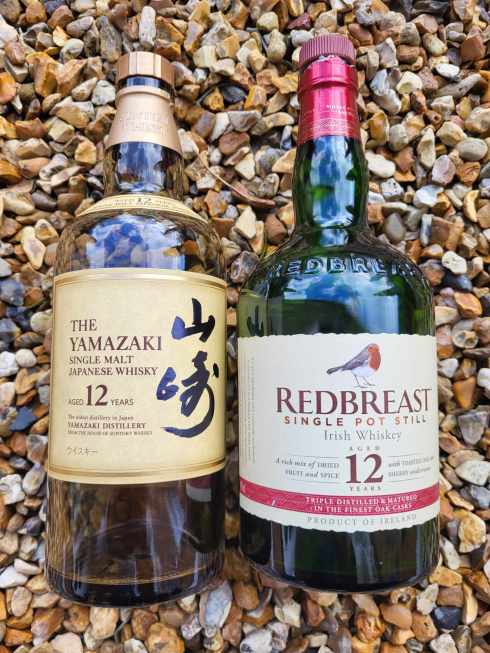
Redbreast 12 Tasting Notes
Nose: Mulled wine, orange peel, cloves, hint of motor oil and mint. This bottle seems more muted than previous Redbreast 12s I’ve had but it’s still there.
Palate: Raisins with ginger spice rolling with oakiness, sweet and bitter. Sweetness like 50% dark chocolate but the bitterness you get is more woody than earthy. Less Christmas-y and buttery than I remember but the Redbreast DNA runs through.
Finish: Flat cola, dry, medium finish.
Score: 6.5/10
Yamazaki 12 Tasting Notes
Nose: Pastries, boiled sweets, strawberries, sticky toffee pudding, lemon wedge in a glass of water. Lots going on, complex, but not as balanced as I remember.
Palate: Orchard fruits, over-riped pear, mint, golden syrup sweetness. Oak comes later and becomes prominent until it gets to a point where it’s rubber then dissipates leaving a touch of syrup sweetness. The more you chew, the more of the sherry you get. Medium body and not overpowering.
Finish: More woody than sweet. Shorter than I remember but good nonetheless.
Score: 6.5/10
Conclusion
It feels like a cop-out to score these drams the same but both really have their own merits and considering everything, they are great whiskeys that offer value to consumers who can spend at these price points. Yes, I will probably drink more Redbreast 12 than Yamazaki 12 but it’s hard to put one dram over the other. If you prefer more sherried whiskeys then Redbreast will probably be your preference but if you like a more balanced sweet and woody whisky, then Yamazaki 12 is for you.
 The Water Of Life
One thought on “Exploring parallels between the Irish and Japanese Whiskey Industries – Review of Redbreast 12 and Yamazaki 12”