The small town of Newburgh in the north of Fife feels far from the established Scottish tourist trail. Despite its scenic location on the Firth of Tay, it seems very much a place that you only drive through on the way to somewhere else, remarking only on the change in speed limits. That is, unless you’re a whisky enthusiast, which might mean that you see Newburgh from an entirely different perspective. This is because, on the edge of town, there is an attraction interesting enough that words like “pilgrimage” might be used to describe a visit.
Andrew and Helen McKenzie Smith’s story seems a little bit like a fairy tale. The family had owned a farm on the edge of Newburgh for years, on which were the ruins of Lindores Abbey. While the history of the abbey was interesting, it stood in an area rich in Scottish history, and only attracted the occasional visitor. All this changed in 2001, when an envelope arrived on their doorstep. Inside this envelope was a hardback copy of a book by Michael Jackson, accompanied by a note inviting them to read its final chapter.
While researching the book, Scotland and its Whiskies, Michael had stumbled on something very interesting: what is believed to be the first written reference anywhere to whisky. An entry in Scottish Exchequer Roll from 1494 read: “To Friar John Cor, 8 bolls of Malt, wherewith to make Aqua Vitae for King James IV”. Aqua Vitae translates from Latin to “the Water of Life”, or “Uisge Beatha” in Gaelic – transformed through the ages to become “whisky”. This John Cor was a monk at Lindores Abbey, and it is believed that the requested Aqua Vitae may have been to quench the King’s thirst during a hunting party at nearby Falkland Palace.
Having learned the significance of their abbey, and following a discussion with Michael Jackson, Andrew and Helen invited a team of archaeologists to investigate the ruins. Amongst many other finds was evidence of a rudimentary still, which was carbon dated to around the time of the Exchequer Roll entry. This left a dilemma: if you own the site where whisky is first recorded as having been made, do you build a visitor centre or a distillery? The McKenzie Smiths opted for both.

Ground was broken for the Lindores Abbey Distillery in 2016, and spirit ran off the stills a year later. While there had been initial interest in the project from the likes of Diageo, Andrew and Helen opted to raise funds only from smaller investors, aiming to maintain a family atmosphere and ensure that they kept control of the project. In 2018, the distillery and visitor centre opened to the public.
Having followed the news of Lindores Abbey Distillery’s founding and subsequently having tried a few of their drams, I finally visited in August 2023. The tour started, as all good ones do, in the bar. The Apothecary Bar was a great venue for our guide Michael to introduce the history of the site, and the story of the distillery’s reformation in the twenty first century. Given the Abbey’s place in history, there was a lot to discuss, with the introduction reaching as far back at the 1100s.

We moved through the beautifully restored farm building (available for small weddings!) to the production floor, where the tour moved away from history and onto the whisky. While distillation has moved on a little since 1494, there was one aspect that the monks would have been familiar with: the proximity of the ingredients. Water is drawn from a 42m borehole on site, which offers excellent pH and mineral content stability, and the barley is all grown within a 5-mile radius. This is malted not far down the road at Crisp in Alloa.
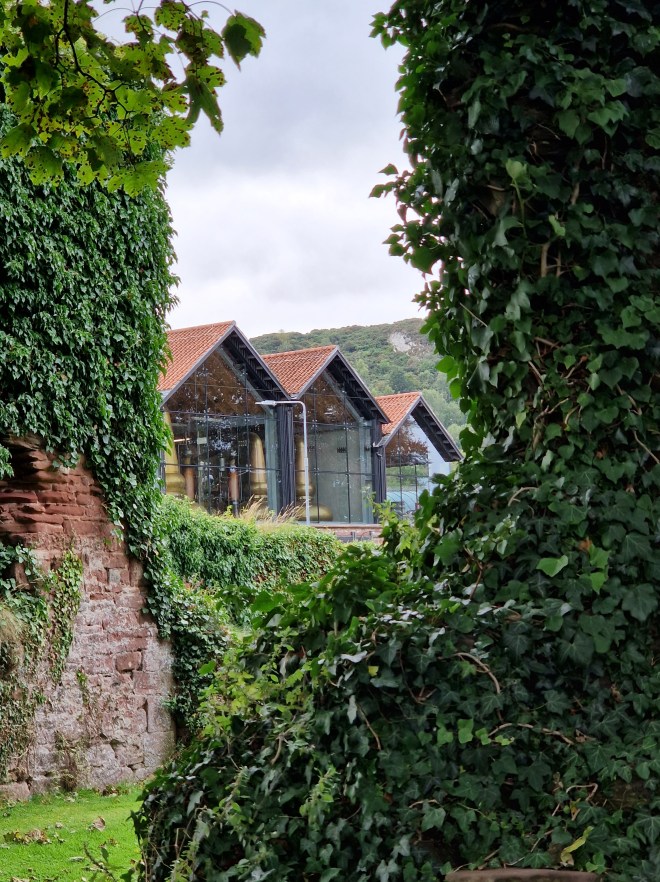
Friar John Cor would not, however, have recognised the fermentation and distillation apparatus. Constructed by, of course, Forsyth’s, these are set on the first floor of the stillhouse, by a large window offering a view of the abbey ruins. If nothing else, it’s worth a visit just to take a photograph.

With a team of only eighteen at the distillery, it’s clear that there is a real family ethos. What is surprising is the age of the team doing the distilling: with most in their thirties, this must be one of the youngest in the industry. As our guide described some of what this team had been up to, it became clear that they are being given plenty of opportunity to experiment. The significant number of single cask releases Lindores is producing is testament to this: they are hard at work trying to get the absolute best out of their spirit while the distillery is still young, so that future, older releases are as good as possible. So far there have been 63 small batch releases as the team tries out different casks and finishes.
There were two facts about the operation at Lindores that I was particularly pleased to hear. Firstly, the distillery is only releasing integrity bottlings, without chill filtration or artificial colouring. Secondly, they are extremely accommodating of private casks, all of which are stored in the onsite warehouse, unlike the distillery’s own casks which are maturing down the road at the larger Morriston Distillery.

As is tradition, the tour finished in the bar. There are two bars: the Apothecary Bar, where the tour starts, which hosts most groups, and the smaller Legacy Bar. We were lucky enough to be hosted in the latter, which is a beautiful venue. The standard tour offers a taste of the flagship MCDXCIV Single Malt, as well as the Aqua Vitae, a new make spirit with herbs and spices that attempts to recreate what Lindores Abbey would have produced for James IV. Other tour packages offer either a flight of small batch releases or even a whisky-chocolate pairing experience.
A tour of the Lindores Abbey Distillery starts at £15 per person and can be booked through the distillery website. Driver packs are offered for those who are unable to drink their samples on the day. Apparently, Lindores Abbey is the only Scottish distillery to welcome dogs throughout the tour.
It is worth discussing Lindores Abbey’s place in the history of whisky. During the tour, it was openly admitted that the site was only linked to the first recorded instance of whisky making and wasn’t necessarily the location that whisky was invented. It would have been an easy leap from the documented evidence to the more extraordinary claim of invention, and I was pleased that it hadn’t been made. Instead, our guide happily admitted that distillation had likely been taking place for a long time before the Exchequer Roll reference. However, without any documentary proof, it is highly unlikely that the true point of origin will ever be known. It has been said that something only becomes history when it is written down; even though it may not be the site where whisky was created, with the documented production of Aqua Vitae at Lindores Abbey, for now we can say that this is the place where whisky entered history.

I have to say that I hugely enjoyed my visit to Lindores Abbey. This is the perfect outing for those who enjoy both whisky and history: even without a distillery, this is a fascinating site which has played host to incredible events. I would suggest that any history enthusiast plans for some extra time before and after their tour to poke around the visitor centre’s exhibition and to explore the Abbey ruins. While the distillery’s whisky is undeniably still young, early signs are encouraging, especially among the small batch releases. A few more years should see Lindores releasing some absolute gems.
In summary, Lindores Abbey certainly has a place in the history of whisky. The visitor centre is beautifully presented: this site is almost too picturesque to be a working distillery. If you’ve not been already, I would highly recommend going out of your way for a visit, or even a pilgrimage.
 The Water Of Life